


Many pagan religions and belief systems are founded upon a vision of divinity manifest in nature. Drawing upon the traditions of our pagan ancestors, many pagans celebrate this vision in seasonal festivals. Nature is the keystone of an understanding of the seasonal rites, which are times of joy and celebration and deep communion with the powers of natural forces.
The turning pattern of the seasons is seen as a wheel. Bach aspect of seasonal change is understood as a mystery of divinity. As the wheel turns, so nature reveals the many faces of the gods. Pagans often shape rituals to express what they see and feel in nature. In doing so, they share in the mystery of the turning cycle and join more closely with the vision of their gods.
Paganism may see humanity and the seasons as part of a single whole. This leads many to the understanding that true well-being for ourselves and for the world in which we live can only be achieved by understanding our relationship with nature. The ravaging of the Earth’s resources, the devastation of the rain forests and the exploitation of the Earth’s natural wealth – these to many pagans are acts of madness.
In their seasonal rites, many pagans pass on a deep vision of human life as part of the natural cycle, taking delight in their vision and reaching out to embrace ever more deeply that whole of which they are a part.
Just as nature is both male and female, so the seasonal celebrations describe the dance between the goddesses and gods throughout the Wheel of the Year. Paganism celebrates what is natural. Birth, life and death are a pattern of which all are a part. Just as great empires rise and fall, just as spring gives way to summer, so men and women are born then die. So the wheel turns, a dance of light and dark and of gods and goddesses throughout the wheel of the seasons.
Pagans celebrate the cycles of sowing and reaping, the passage from winter to spring then to summer and autumn. Pagans learn to accept that there are times of growth, but also times of old age and death. In all things, there is wisdom to be learned, not just in what is bright and new: there is also deep knowledge and vision in those things old and dark.
The seasonal festivals are mysteries, yet they are so simple a child might understand. They are times when pagans remember the cycle of life of which they are a part and touch a simple pagan truth that humanity and the world are one – part of a whole bound in love.
The Wheel of the Year is celebrated in a myriad of forms in the different pagan religions. Pagans of nearly all paths celebrate at least the two solstices and the two equinoxes, but there are variations between religions and between geographical regions with different climatic conditions.
It is not possible to look at all these variations, but some idea of the underlying themes celebrated during seasonal rites can be described. If we look at the cycle of eight seasonal festivals below, which is based mostly on the Celtic & Wiccan religions, we can see that four are marked by the equinoxes and solstices while four are Celtic festivals: Imbolc, Beltane, Lughnasadh and Sainhain. The dates given are those for the northern hemisphere.
The Wheel of the Year
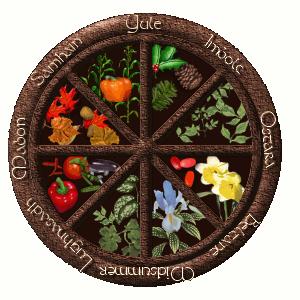
Samhain – 31st October (pronounced Sow-in):
The Wheel of the Year is seen to begin at Samhain, which is also known as Hallowe’en or All Hallows’ Eve. This is the Celtic New Year, when the veil between the worlds of life and death stands open. Samhain is a festival of the dead, when many pagans, particularly Celtic pagans, remember those who have gone before and acknowledge the mystery of death. As pagans, many of us celebrate death as a part of life.
Yule – 21st December (archaic form Geola, pronounced Yula):
Yule is the time of the winter solstice, when the sun child is reborn, an image of the return of all new life born through the love of the gods. The Norse had a god named Ullr, and within the Heathen traditions Yule is regarded as the New Year.
Imbolc – 2nd February:
Imbolc, also called Oimelc and Candlemas, celebrates the awakening of the land and the growing power of the Sun. Often, the Wiccan Goddess is venerated in her aspect as the Virgin of Light and her altar is decked with snowdrops, the heralds of spring.
Spring Equinox – 21st March:
Now night and day stand equal. The Sun grows in power and the land begins to bloom. By spring Equinox, the powers of the gathering year are equal to the darkness of winter and death. For many pagans, the youthful God of the Hunt with his hunting call leads the way in dance and celebration. Others dedicate this time to Eostre the Anglo-Saxon goddess of fertility.
Beltane – 30th April:
The powers of light and new life now dance and move through all creation. The Wheel continues to turn. Spring gives way to summer’s first full bloom and Celtic pagans celebrate Beltane with maypole dances, symbolizing the mystery of the Sacred Marriage of the Wiccan Goddess and God.
Midsummer – 21st June:
At summer solstice is the festival of Midsummer, sometimes called Litha. The Wiccan God in his light aspect is at the height of his power and is crowned Lord of Light. It is a time of plenty and celebration.
Lughnasadh – 1st August (pronounced Loo-nassa):
Lughnasadh, otherwise called Lammas, is the time of the corn harvest, when the followers of many pagan religions reap those things they have sown; when they celebrate the fruits of the mystery of nature. At Lughnasadh, Wiccans give thanks for the bounty of the Goddess as Queen of the Land.
Autumn Equinox – 21 September:
Day and night stand hand in hand as equals. As the shadows lengthen, many pagans see the darker faces of the gods and goddesses. For many, this rite honours old age and the approach of winter.
Samhain – 31st October:
The Wheel turns and returns to Samhain, the festival of the dead, when we face the gods in their most awesome forms. This is not a time of fear, but a time to understand more deeply that life and death are part of a sacred whole.

Leave a comment
You must be logged in to post a comment.